Home / Gait speed
Gait speed: the functional vital sign
What it is, how to interpret it, what it predicts from midlife to old age and why it is worth measuring with an automated system.
Gait speed is a functional vital sign
Walking requires the heart, lungs, muscles, balance and brain all at once. That is why a few seconds over 4 metres summarise an older person’s functional reserve better than many longer tests.
lower risk of death for every additional 0.1 m/s
In 34,485 older adults from 9 cohorts, every additional 0.1 m/s of gait speed was associated with a lower risk of death (HR 0.88).
Studenski et al., JAMA 2011frailty criterion in the 2026 Spanish National Health System consensus
The update approved in April 2026 uses 4-metre gait speed, together with the SPPB, TUG and FRAIL, to detect frailty, which affects around 18% of older people.
Spanish Ministry of Health, 2026risk of dementia when memory and gait both decline
People whose memory and gait speed decline at the same time have a 6.28 times higher risk of dementia. Measuring gait speed repeatedly tells you more than a single measurement.
Tian et al., JAMA Network Open 2020Not just for older people: gait speed tells a story from age 45
Large studies show that the way we walk already reflects biological ageing in midlife, decades before frailty appears. Measuring it early means acting sooner.
Accelerated ageing and brain health
Among 904 members of the Dunedin cohort measured at age 45, those who walked more slowly showed accelerated biological ageing and poorer brain and cognitive function.
Rasmussen et al., JAMA Network Open 2019Longer life expectancy
In the UK Biobank, people who reported a brisk walking pace had a longer life expectancy, estimated at age 45, regardless of their weight.
Zaccardi et al., Mayo Clinic Proceedings 2019Longer telomeres
A steady or brisk walking pace was associated with longer telomeres, a marker of biological age, in middle-aged adults. Genetic analysis points to a causal relationship.
Dempsey et al., Communications Biology 2022In the UK Biobank studies, walking pace was self-reported by participants. SpeedAge measures it objectively and tracks how it changes.
Frailty and falls: a first-order problem
Frailty is a state of vulnerability that is not an inevitable consequence of ageing: it can be detected in time and, in its early stages, reversed.
Source: Spanish Ministry of Health, press release of 9 April 2026 on the update of the frailty and falls consensus.
Frailty is present in every hospital clinic
Prevalence of frailty by clinical setting according to the FRAILCLINIC study. Among community-dwelling older people it is around 12%.
Gait speed in guidelines and specialties
The same number, a few seconds over 4 metres, appears in geriatrics, primary care, cardiology and neurology.
2026 Spanish National Health System consensus
Frailty detection criterion, together with the SPPB, TUG and FRAIL. The consensus promotes active case-finding of people aged 70 or over from primary care, social and health care centres, pharmacies and social services.
Spanish Ministry of Health, 2026Severe sarcopenia (EWGSOP2)
The European consensus uses gait speed as a measure of physical performance: when it falls below 0.8 m/s, sarcopenia is considered severe.
Cruz-Jentoft et al., Age and Ageing 2019Mortality in cardiac surgery
In 15,171 patients aged 60 or over, every 0.1 m/s decrease in gait speed before surgery increased operative mortality by 11%, independently of the STS risk score.
Afilalo et al., JAMA Cardiology 2016Cognitive decline
A combined decline in memory and gait speed multiplies the risk of dementia. Slow gait precedes the diagnosis, and measuring it repeatedly tells you more than measuring it once.
Tian et al., JAMA Network Open 2020A change of 0.05 m/s matters. A stopwatch does not always catch it.
In older people, a change of 0.05 m/s is already clinically meaningful and one of 0.10 m/s is substantial. Over 4 metres, that is tenths of a second: exactly where manual timing, the moment the button is pressed or the way the test is started introduce variation.
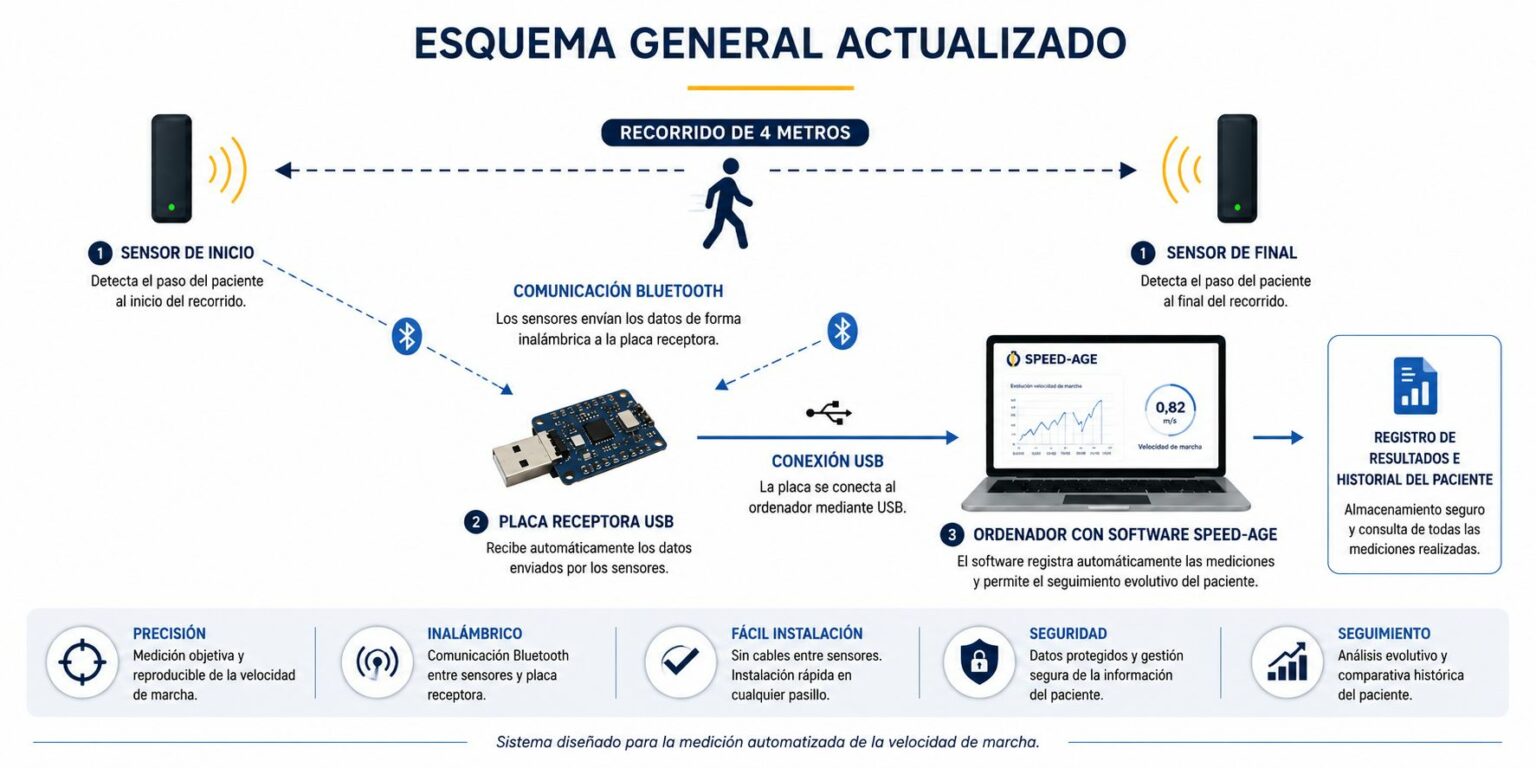
- The sensors mark the start and the end; nothing depends on the assessor’s reflexes.
- The same protocol for every measurement, in every centre and with every professional.
- Bluetooth sensors, USB receiver board and central computer: the result is saved instantly, with no times copied by hand.
- Progress charts show the response to exercise, nutrition or treatment.
How long a relevant change takes over 4 metres
Time difference for a person walking at 0.8 m/s (5.0 s over 4 m)
Calculated from the change thresholds in Perera et al., J Am Geriatr Soc 2006. Manual timing depends on two button presses by the assessor: any delay in them falls within this same order of magnitude.