Home / Longevidad Activa™
Longevidad Activa™: a working method for assessing physical function
Three validated devices used in clinical practice and research, and a single report that brings together gait speed, grip strength and body composition, so you can act before independence is lost, in the clinic, in the care home or at home.
What is Longevidad Activa™
Longevidad Activa™ (Active Longevity) is a working method for assessing physical function. It measures the key indicators of functional health (gait speed, grip strength and body composition) and, with the objective data the devices provide, makes it possible to decide and work as effectively as possible with each person.
It is the result of experience in active ageing built up since 2018, with a clear goal: helping each person keep their mobility, independence, functional capacity and quality of life for longer.
We start from a simple idea: health should not focus only on treating disease once it appears, but on measuring function before it is lost. That is why we combine objective functional assessment, frailty prevention and specialised training, with a multidisciplinary team with extensive experience in teaching and in day-to-day work with older people.
Eforto and BIODY XPERT ZM3 images: Eforto BV and Aminogram.
A method in three stages
Health is not only about treating disease once it appears. Longevidad Activa™ aims to detect the first signs of functional loss and measure every change in order to decide in time.
Prevention
Acting before function is lost. The method applies from age 35, with an individual baseline, and gait speed already reflects biological ageing at 45: measuring early makes it possible to guide exercise, nutrition and muscle health while there is still plenty of room to act.
Detection
Fast, objective screening with three devices: functional performance, muscle capacity and body composition. It detects frailty, sarcopenia and nutritional risk that go unnoticed in daily practice.
Follow-up and records
Every measurement is stored in the person’s record and compared with previous ones. This shows whether an intervention is working and reveals any loss, however small.
Report for the patient
One single report, three devices
The patient receives a single document with their gait speed, grip strength and body composition: a complete view of their functional status, clearly explained and easy to compare at every review.
- Body composition (BIODY XPERT ZM3): a target chart with hydration, water balance, BMI, fat mass, muscle and bone mineral content, and the change in fat mass, muscle mass and water.
- Gait and chair test (SpeedAge®): gait speed and time for five chair rises.
- Strength and fatigue (Eforto®): maximum grip strength, grip work per kilo of body weight, grip endurance, energy capacity and perceived physical fatigue.
- Functional interpretation and follow-up recommendations: measure, act and measure again.
Report for the patient and reports for the doctor
The doctor or health professional sees the full report from each device, with all the technical data needed to assess, decide and follow up. The patient receives the Longevidad Activa™ report: a single page with the essentials of all three, a functional interpretation and recommendations they can understand.
Report for the doctor: gait and physical function
Gait speed and functional status, five-repetition chair stand test (5STS), SPPB and MMSE, with warning indicators, exercise recommendations and nutritional advice.
Report for the doctor: strength and fatigue
Grip strength, total grip work and grip work per kilo of body weight, fatigue resistance time, energy capacity (CPV) and perceived fatigue (MFI-20), compared with the previous week and month, with progress charts.
Report for the doctor: body composition
Fat mass, muscle mass and water compared with their theoretical values, phase angle, fat mass and fat-free mass indices with age percentiles, skeletal muscle mass, protein mass, minerals and water balance.
Real reports with personal data removed.
The three devices
Three validated devices used in clinical practice and research. Each one measures a key indicator of functional health and, together, they give a complete picture of the person.
1 · Functional performance
SpeedAge®
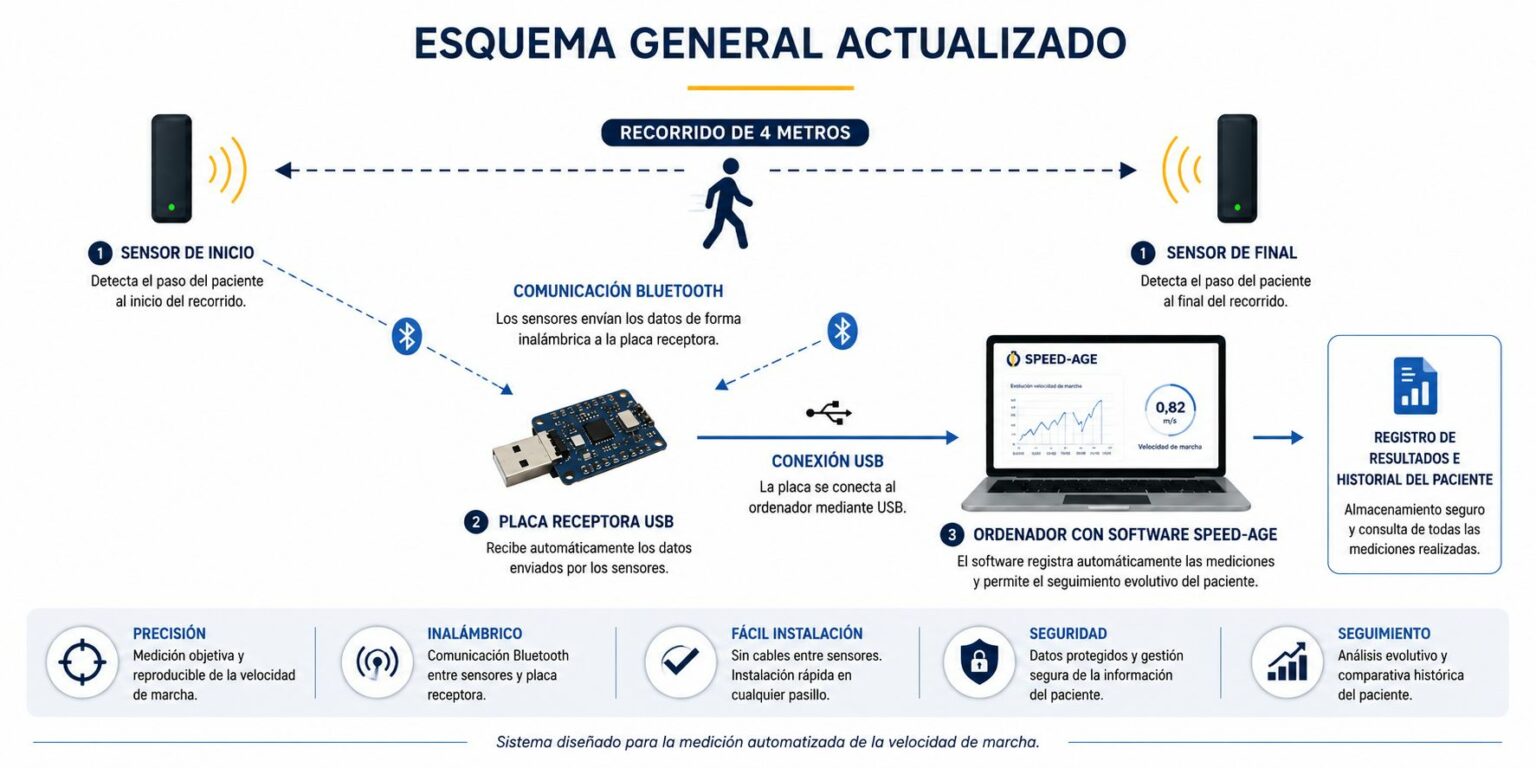
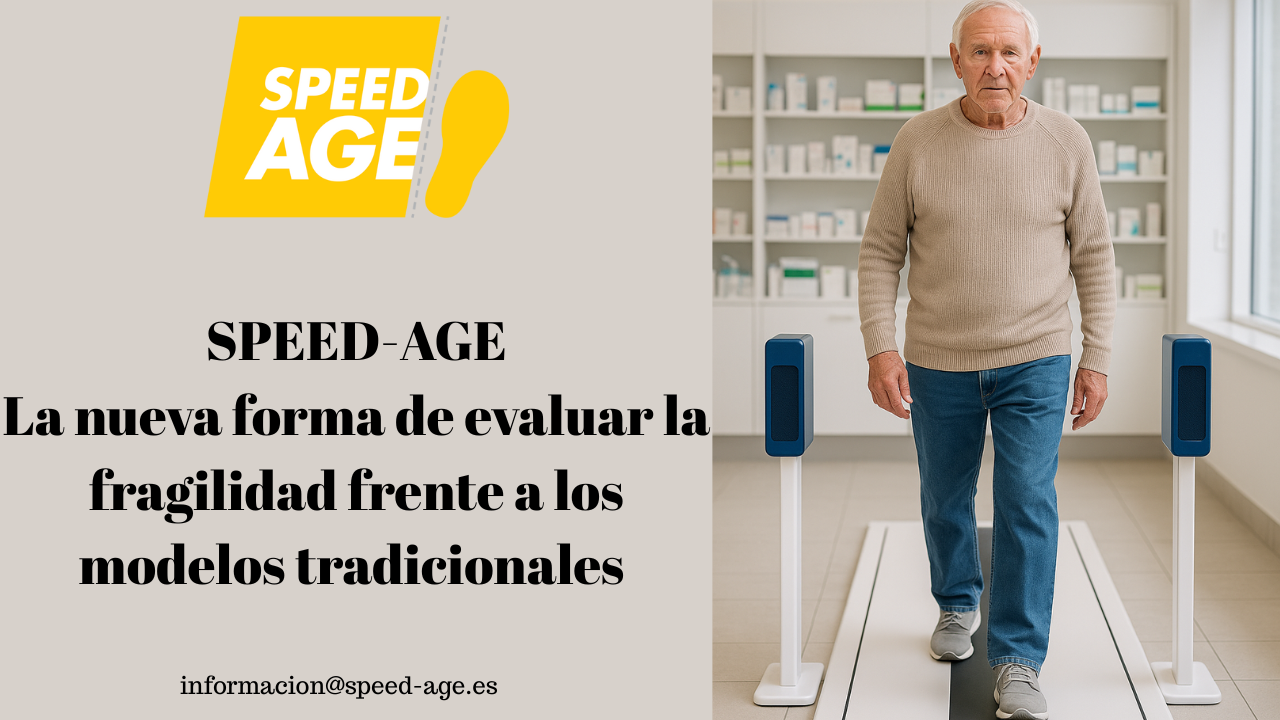
An automated 4-metre gait walkway, born in the Geriatrics Department of Albacete General Hospital. Two wireless sensors record the start and the end of the walk and send them via Bluetooth to a receiver board connected by USB to the central computer: no stopwatch and no cables on the floor.
- Gait speed in m/s, to the hundredth, without depending on the assessor’s reflexes.
- Interpretation against the 0.8 m/s frailty cut-off.
- SPPB and Barthel Index recorded in the person’s history.
- Progress charts that show losses as small as 0.02 m/s.
- Portable system with stands that are easy to set up and take down: a single device can be used in several care homes or centres.
Gait speed is one of the best indicators of functional performance: it is linked to mobility, independence, falls and survival, and reflects biological ageing from age 45.
2 · Muscle strength and endurance
Eforto®
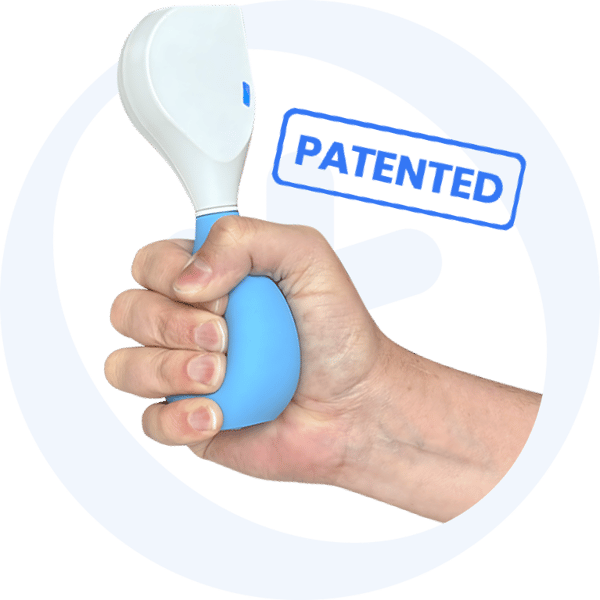
A system for monitoring muscle health and vitality capacity, developed by the Belgian company Eforto BV. It combines a vigorimeter, an app that guides the test with validated protocols and a monitoring platform. Its manufacturer presents it as the first validated effort test for measuring vitality capacity as defined by the WHO.
Registered as a Class II medical device by the FDA in the USA. In Europe, its certification as a Class IIa medical device (MDR) is in progress.
- Vigorimeter with an ergonomic bulb instead of a classic isometric dynamometer: reliable with different hand sizes and usable even by the weakest people, from 100 g.
- Medical-grade pressure sensor that calibrates itself before each test.
- Guided maximal effort test in under 5 minutes, with checks that ensure the effort really is maximal.
- Traffic-light results: green (normal), yellow (at risk, possible pre-frailty) and red (very low, often associated with frailty), with separate references for men and women.
What it measures
- Maximum grip strength.
- Fatigue resistance: the seconds the person keeps their force above 50% of their maximum.
- Grip work: the total work of the hand muscles, the area under the force-time curve, also adjusted for body weight to compare between people.
- Perceived fatigue reported by the person.
Two people can have the same maximum strength and very different endurance. Low muscle endurance is associated with frailty in older people, even in octogenarians who felt well, and together with high perceived fatigue it precedes the decline in gait speed and in activities of daily living. It can be improved at any age with strength and endurance training and adequate nutrition.
Sources: eforto.com · De Dobbeleer et al., Aging Clin Exp Res 2023 (validity and reliability in older people) · Bautmans et al., Lancet Healthy Longevity 2022 (WHO definition of vitality capacity)
3 · Body composition
BIODY XPERT ZM3
A body composition analyser using bioimpedance spectroscopy (BIS), manufactured by Aminogram in La Ciotat (France). It measures with four electrodes and a frequency sweep from 1 to 1,000 kHz. It is a CE-marked medical device (Class IIa, European MDR regulation).
A 2-in-1 device: with or without cables
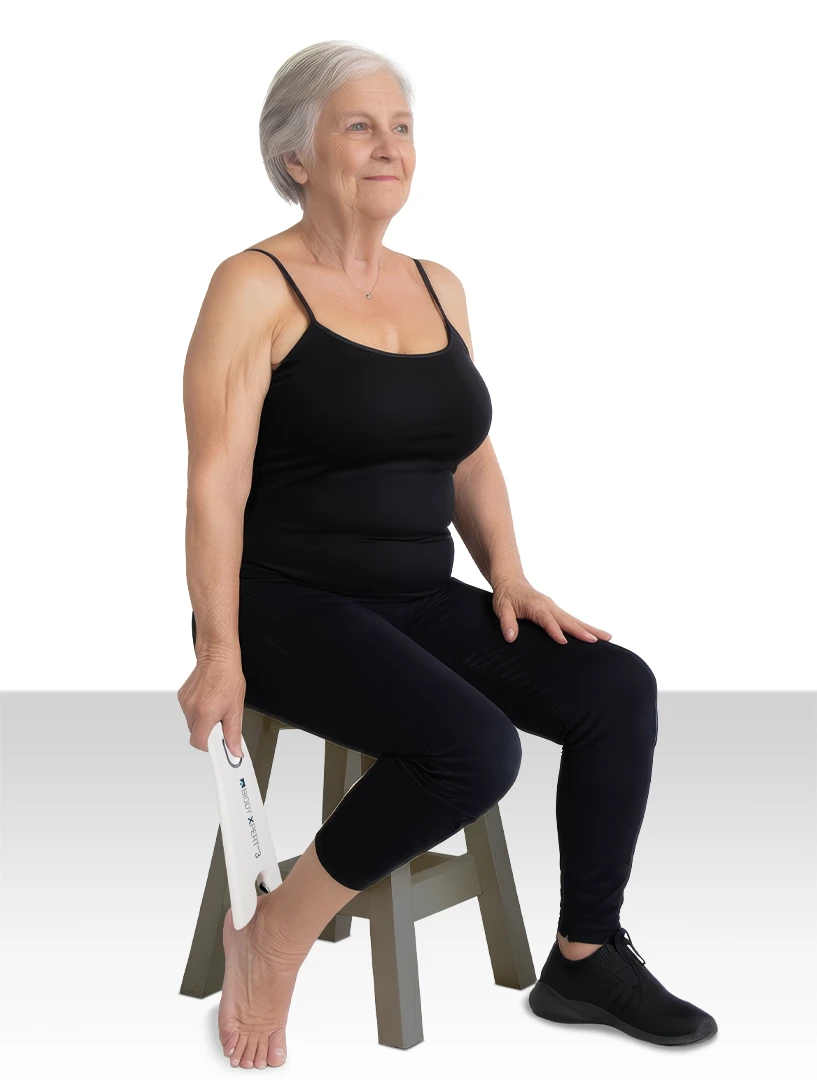
The person holds the device, which has touch electrodes and a patented hand-to-foot measuring system. The Touch’n start function detects contact and starts the measurement automatically, with visual and audio guidance, and the result arrives in about 10 seconds. No disposable electrodes are needed.
For people with reduced mobility or who are bedridden: adhesive electrodes are placed on the patient and connected to the device with the two cables supplied, as in the classic method.
- Light and portable: 300 g and 29 × 6 cm, with rechargeable batteries and Bluetooth 5. It goes to the clinic, the pharmacy, the care home or the patient’s home.
- Ergonomic, adapted to different sizes and body shapes: from children to bedridden patients.
- Accuracy of 1% in impedance and 0.2° in phase angle.
- Biody Manager software: each patient’s history and progress, and personalised reports, from a computer, tablet or mobile phone (Android and iOS).
What it measures
- Fat mass, fat-free mass and dry fat-free mass; BMI broken down into fat mass index (FMI) and fat-free mass index (FFMI).
- Skeletal muscle mass and its total (SMI) and appendicular (ASMI) indices.
- Body cell mass and metabolic protein mass.
- Total body water, water balance between extracellular and intracellular water, and hydration of fat-free mass.
- Bone mineral content.
- Phase angle, impedance ratio and Cole-Cole plot.
- Basal metabolic rate and energy requirements.
- Differences compared with theoretical values, age percentiles and progress history, with results classified as normal, to monitor or to treat.
Weight and BMI are not enough: bioimpedance separates fat mass, muscle mass and hydration, and helps detect malnutrition, sarcopenia and sarcopenic obesity early. Phase angle, which tends to decrease with age, makes it possible to follow the state of the cells and muscle and adjust the intervention.
Sources: aminogram.com · product sheet
Wherever the person is: care homes and home care
All three devices are portable. Longevidad Activa™ is used in clinics and pharmacies, but also in care homes and in people’s own homes, and it stands out for what it brings to home care.
One device for several centres
SpeedAge® has a portable system with stands that are easy to set up and take down. A single device can be taken from one care home to another to measure residents in several centres and follow their progress with the same protocol.
Functional assessment at home
Eforto® is a handheld vigorimeter, the BIODY XPERT ZM3 weighs 300 g and SpeedAge® sets up along any 4-metre path. Taking the assessment to people’s homes makes it possible to measure those who cannot travel and detect loss of function in time.
Bedridden patients too
The BIODY XPERT ZM3 is 2-in-1: it measures wirelessly, with its hand-to-foot system, or with cables and adhesive electrodes, as in the classic method. This makes it possible to assess the body composition of bedridden patients or people with reduced mobility, in the care home or at home.
How the method works
Longevidad Activa™ is a documented method that brings all of a person’s measurements together in a single report, to avoid fragmented readings and turn them into a preventive, prioritised interpretation that is followed over time.
What is measured
- Mobility: usual gait speed over 4 metres, with SpeedAge®.
- Lower limbs: five-repetition chair stand test.
- Strength: maximum grip strength, with Eforto®.
- Fatigability: sustained strength and grip work, with Eforto®.
- Anthropometry: weight, height and BMI.
- Body composition: fat mass, muscle, water and phase angle, with the BIODY XPERT ZM3.
- Biological markers available in the person’s blood tests.
- Trajectory: comparison with the baseline and with previous measurements.
From age 35
The method applies to adults from age 35. Each person has their own baseline and their results are compared with published references by age and sex.
Function first
No single figure decides on its own. Good body composition or good blood results do not hide a loss of strength or mobility, and a decline from the baseline triggers follow-up even if the value is still within normal limits.
The reports
The doctor reviews the full report from each device; the patient receives a single report covering all three, with a maximum of three to five goals, recommendations and the date of the next measurement.
Five clear categories
Scope. The Longevidad Activa™ Method does not make clinical diagnoses: it measures, interprets, stratifies and follows up functional indicators and risk factors. Recommendations are preventive and respect the scope of practice of each professional. When warning signs or a relevant decline appear, the method sets out reassessment or referral to the appropriate health professional.
Companies, insurers, networks of centres and laboratories
This method is yours
Longevidad Activa™ is a method ready to bring to your organisation: the same protocol, the same devices and the same report in every centre, to offer active longevity with demonstrable results and treatment adherence.
National companies: health for employees and customers
Health and active ageing programmes for employees, customers or members, with objective measurements and a clear report for each person.
Measurable prevention for policyholders
Functional assessment of policyholders to detect frailty and the risk of falls and dependency in time, and to measure the effect of prevention programmes.
Centres with sites across Spain
Clinics, pharmacies, care homes or sports centres with several sites: a common protocol and portable devices make it possible to compare results between centres and follow each person wherever they are measured.
Products to reverse frailty, assessed with data
Objective assessment of recommended products aimed at reversing frailty and restoring physical function: gait speed, strength, fatigue and body composition, measured before and after.
Where it is used
For professionals and centres that want to measure physical function objectively and follow its progress.
Screening of physical function and nutritional risk close to the person, with follow-up at every visit.
Geriatrics, nutrition, physiotherapy and general medicine: objective data to decide and explain.
Portable devices to measure in several care homes, at home and in bedridden patients, following the response to exercise and nutrition.
Measurements comparable across centres and assessors for studies and frailty units.
Would you like to bring Longevidad Activa™ to your centre?
We will explain the method, the devices and the report, and prepare a tailored proposal.
Or write to us at informacion@speed-age.es